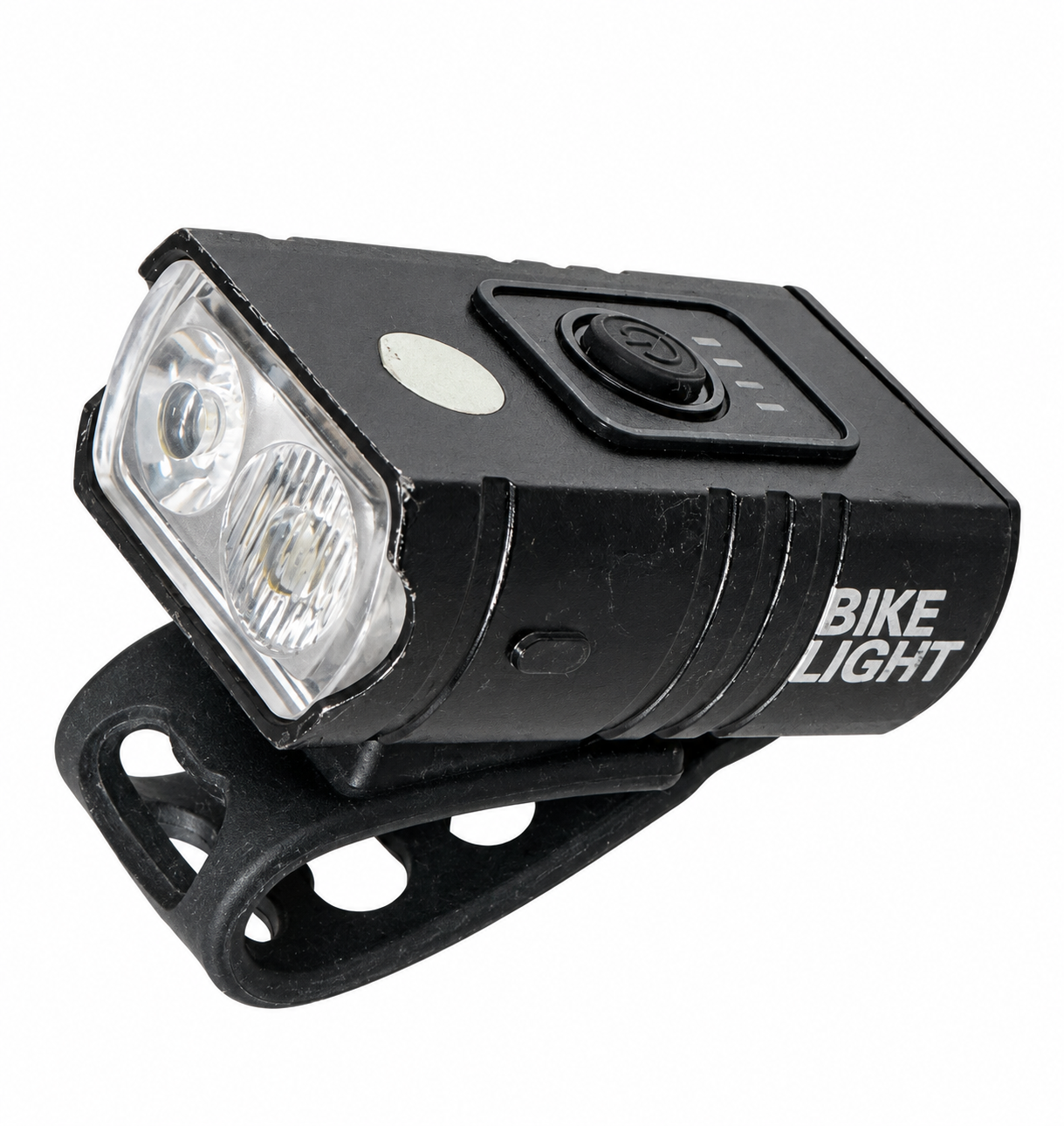
There’s probably a million different models of bike lights out there. This one ain’t particularly special: it’s not the lightest, not the brightest, not the one with the longest charge.
Nevertheless, it’s brilliantly simple and just works. You can charge it with USB (there’s a caveat to this though that I’ll mention later, so keep reading!). It snaps around your handlebar with a rubber strap that’s solid enough for most use. You can rotate it on top of that rubber strap so you can adjust the light wherever it needs to go. There’s different brightness settings that you can cycle through with the on/off button. Or, you know, long press it to turn off again. Simple as that.
Yes, you can also make it blink instead of permanently light up. Please don’t do that. Cyclists here in London seem to like doing this and I kinda get it: in theory, motorists will potentially be more likely to see you when you’re blinking. The big downside though is that it’s f**king annoying: in many cases the lights aren’t properly aligned as well so when someone is coming towards you like this, it’s like a blinding stroboscope shining directly into your eyes.
Especially on narrow bike lanes, that’s actually quite dangerous: It’s gets harder to gauge distances and it’s generally confusing, so I’m 100 % certain, there must’ve been quite a few head-on collisions just because of these annoying blinking lights.
So what about the charging caveat: these lights are super cheap and they come from AliExpress/Temu and were designed during a time, where USB-C was not yet a ubiquitous standard, thus using Micro-USB. Now, back then USB would only allow one voltage: 5 V. Nowadays, the USB-C standard allows a range of different voltages and requires the manufacturer to let the devices negotiate the correct voltage before transmission (which is actually super cheap and built into most charging circuits by default today). Well, not here: these expect 5 V no matter what and if the charger doesn’t provide it, they don’t request it – they just won’t charge.
The genius workaround: use a USB-C to C cable that uses the legacy 5 V mode and doesn’t allow any other voltage. If you ever bought some cheap Chinese manufactured USB-C devices, you’ll have seen them before.
There goes the promise of USB-C: just plug any device into any cable and it’ll work. LOL.
Leave a Reply